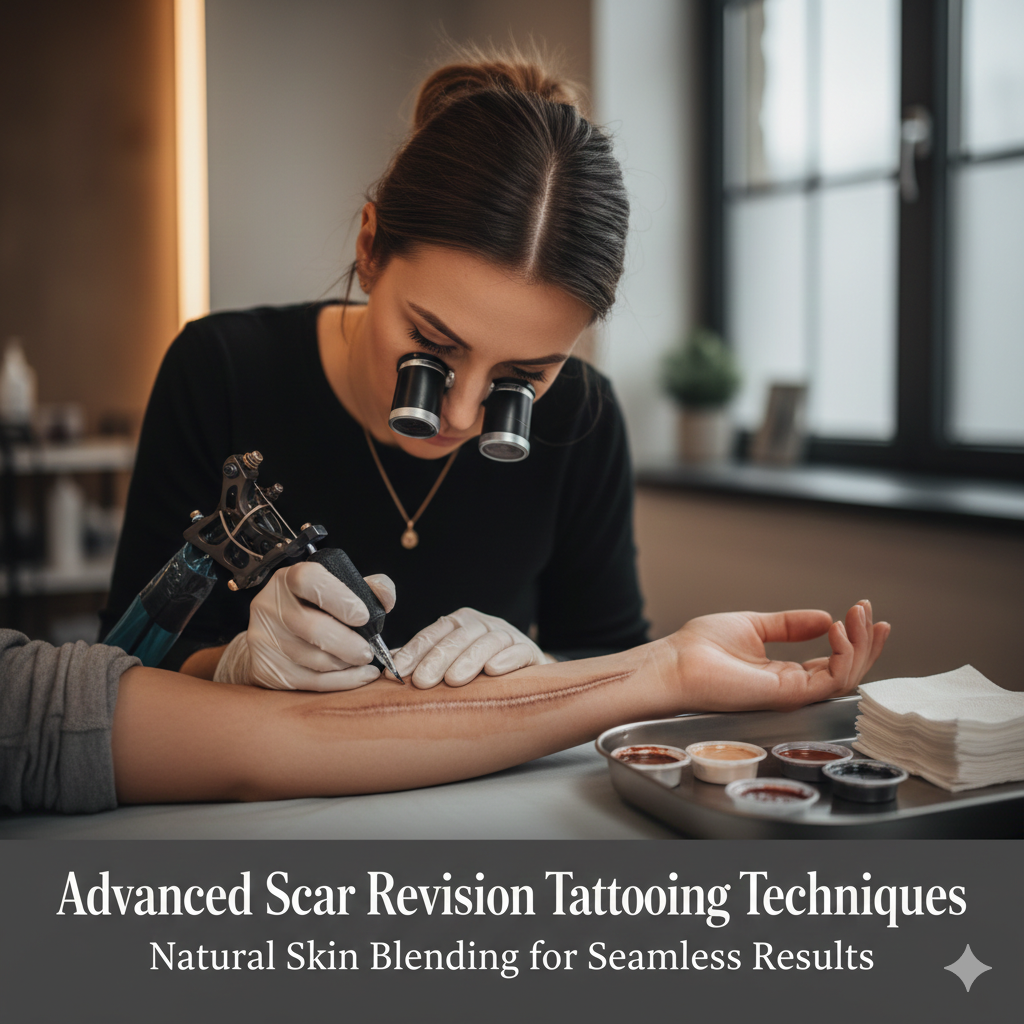
Scar camouflage has evolved far beyond basic pigment application. Today, advanced scar revision tattooing techniques focus on realism, skin behavior, and long-term results rather than simply covering a scar. For clients who feel self-conscious about visible scars, these modern techniques offer a refined, restorative solution that supports both appearance and confidence.
At Beyoutiful Ink, scar revision tattooing is approached with precision, patience, and a deep understanding of how skin heals and ages.
Why Traditional Scar Camouflage Often Falls Short
Older scar camouflage methods relied heavily on single-tone pigment application. While this could reduce contrast temporarily, results often appeared flat, unnatural, or mismatched once healed. Scar tissue behaves differently than healthy skin, absorbing and retaining pigment unevenly.
Without accounting for texture, undertones, and movement, results may fade unpredictably or become more noticeable over time. This is why advanced scar revision tattooing techniques are now the standard for clients seeking natural-looking outcomes.
What Makes Scar Revision Tattooing “Advanced”
Advanced scar revision tattooing techniques combine artistry with skin science. Instead of masking scars, these methods focus on blending them into surrounding skin using layered pigment strategies and customized color correction.
Key differences include:
-
Multi-tone pigment layering instead of single-color coverage
-
Gradual application across multiple sessions
-
Careful consideration of scar texture and elasticity
-
Pigment selection designed to age naturally within the skin
These elements work together to create results that look realistic in different lighting, from various angles, and during movement.
Understanding Scar Tissue and Skin Behavior
Scar tissue differs from normal skin in several important ways. It may be thicker or thinner, have reduced elasticity, and lack natural pigmentation. Some scars appear lighter, while others retain redness or darker tones depending on how they healed.
Advanced scar revision tattooing techniques begin with a detailed assessment of the scar’s age, texture, and stability. Fully healed scars respond best, as the skin has completed its natural repair process.
By understanding how each scar behaves, artists can adjust pigment depth, pressure, and layering to support even healing and natural blending.
Techniques That Create More Natural Skin Blending
Customized Color Matching and Undertone Correction
Natural skin tone is not uniform. It contains undertones of red, yellow, olive, or neutral hues that vary from person to person. Advanced scar revision tattooing techniques use multiple pigments to replicate these subtle variations.
Rather than matching the surface color alone, undertone correction ensures the scar blends seamlessly with surrounding skin once healed.
Layered Pigment Application
One of the most important advancements in scar revision tattooing is layered application. Pigment is introduced gradually over multiple sessions instead of being heavily applied at once.
This allows the skin to heal naturally between sessions and gives the artist opportunities to refine color balance as the pigment settles. Layering also reduces the risk of over-saturation or unnatural coloration.
Texture-Aware Application Methods
Scar texture affects how pigment sits in the skin. Raised, indented, or uneven scars require specialized techniques to ensure even distribution.
Advanced scar revision tattooing techniques adapt needle depth and movement based on texture, helping the pigment blend visually rather than highlighting irregularities.
Strategic Light Diffusion
Rather than trying to eliminate a scar entirely, modern techniques focus on diffusing light across the area. By breaking up sharp color contrasts, scars become less noticeable to the eye, especially in natural lighting.
This optical blending approach creates more realistic results than traditional cover-up methods.
Who Is a Good Candidate for Advanced Scar Revision Tattooing?
Clients with mature, fully healed scars are typically the best candidates. This includes scars from surgery, injury, or medical procedures that have stabilized in color and texture.
A professional consultation is essential to determine suitability. At Beyoutiful Ink, factors such as scar age, skin type, and personal expectations are carefully evaluated before treatment begins.
The Importance of Realistic Expectations
Advanced scar revision tattooing techniques can significantly improve the appearance of scars, but they do not remove scars entirely. The goal is natural blending, not perfection.
Clients who understand and align with this goal are more likely to be satisfied with their results. Clear communication and education are central to the treatment process.
Healing, Aftercare, and Long-Term Results
Healing plays a critical role in the final outcome. Pigment may appear darker or warmer initially, then soften as the skin heals. Proper aftercare supports even healing and pigment retention.
Because advanced scar revision tattooing techniques are designed to age naturally, results often improve in appearance over time rather than becoming more noticeable.
Why Professional Expertise Matters
Scar revision tattooing requires advanced training and experience. Incorrect pigment choice, depth, or technique can draw attention to a scar rather than blending it.
At Beyoutiful Ink, treatments are performed with precision and care, ensuring results that respect both skin health and long-term aesthetics.
FAQs: Advanced Scar Revision Tattooing Techniques
How long must a scar be healed before scar revision tattooing?
Most scars should be fully healed and stable, often at least 12 months old. A consultation is necessary to assess readiness.
Can advanced scar revision tattooing completely hide a scar?
The goal is natural blending, not complete removal. Advanced scar revision tattooing techniques reduce contrast and visibility but do not eliminate scars entirely.
How many sessions are usually needed?
Most clients require multiple sessions to achieve optimal blending. This allows pigments to be layered gradually and adjusted as the skin heals.
Does scar revision tattooing work on all skin tones?
Yes, when performed correctly. Advanced techniques use customized pigments to accommodate a wide range of skin tones and undertones.
Is scar revision tattooing permanent?
Results are long-lasting but may soften over time. Touch-ups may be recommended depending on skin type and lifestyle factors.
Is the procedure painful?
Sensitivity varies depending on the scar and individual tolerance. Most clients describe the sensation as manageable, and comfort is prioritized throughout the session.